Authority Score Explained: How to Measure Domain Strength Without Relying Only on Ahrefs DR
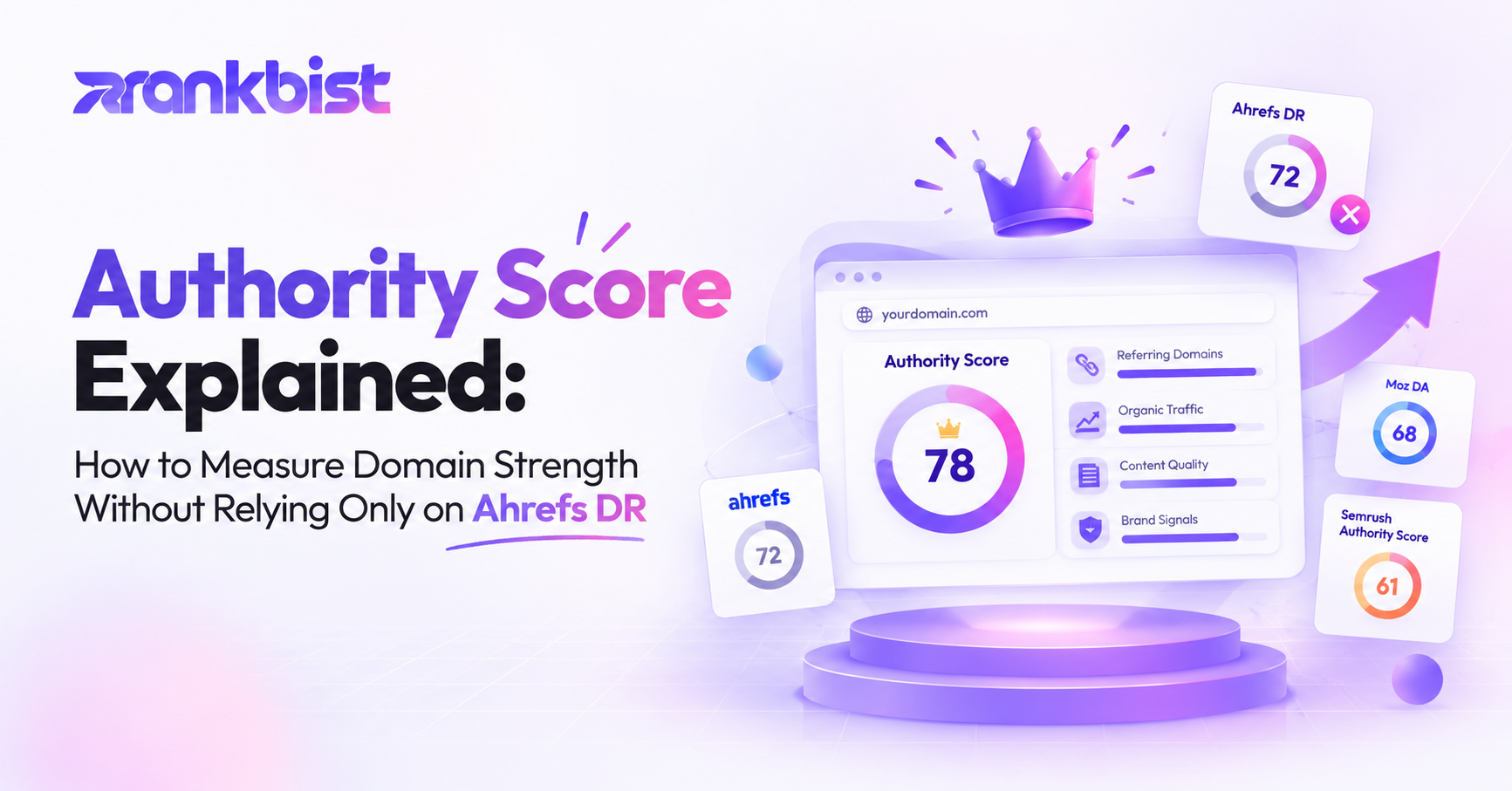
Domain strength metrics are among the most commonly referenced numbers in SEO. Ahrefs Domain Rating (DR), Moz Domain Authority (DA), Semrush Authority Score, and similar metrics attempt to summarize how strong or influential a domain is based primarily on its backlink profile.
Rankbist’s Authority Score is another approach to the same problem. It is useful — but only if you understand what it measures and what it does not.
What Authority Score Tries to Capture
Authority Score is a 0–100 metric designed to reflect the overall strength of a domain based on the public web graph. It considers the quantity and quality of referring domains and their own relative strength.
Like other domain-level metrics, it is a comparative score. A site with a higher Authority Score is estimated to have a stronger overall backlink profile than a site with a lower score, according to the data source and algorithm used.
How It Differs from Ahrefs DR and Similar Metrics
Different tools use different crawls of the web, different update frequencies, different link quality filters, and different calculation methods. As a result:
- Scores are not directly interchangeable.
- A site can have a noticeably higher score in one tool than another.
- Trends within the same tool are usually more meaningful than absolute comparisons across tools.
Authority Score is built from a large public web graph (Common Crawl-derived data). This means it reflects a broad sample of the web rather than a proprietary crawl. The trade-off is that it may not capture every link that a dedicated commercial crawler finds, and the freshness of data depends on the underlying graph updates.
What Authority Score Is Good For
Relative Comparisons
Comparing several domains in the same niche gives a useful directional signal. If competitors consistently show higher scores, they generally have stronger backlink profiles.
Tracking Progress Over Time
Watching your own Authority Score (and referring domain count) over quarters helps confirm whether link acquisition efforts are compounding.
Prioritizing Outreach or Competitive Analysis
When evaluating potential link targets or competitors, the score provides a quick filter before deeper manual review.
What Authority Score Cannot Tell You
It Is Not a Ranking Factor
Google does not use Ahrefs DR, Moz DA, or Rankbist Authority Score. These are third-party estimates. Google’s own systems evaluate links very differently and at a much more granular level.
It Does Not Measure Content Quality or Relevance
A high score means relatively strong backlinks. It says nothing about whether the site’s content is helpful, accurate, or well-aligned with search intent.
It Can Be Influenced by Link Types Google May Discount
Any metric based on raw or lightly filtered link data can be affected by low-quality or manipulative links. Always inspect the actual referring domains.
Absolute Numbers Are Less Important Than Context
A score of 40 in a competitive YMYL niche may be weak. The same score in a small local niche may be strong. Context matters more than the raw number.
A Better Way to Evaluate Domain Strength
Use Authority Score as one input among several:
-
Referring domains and their quality
Look at who actually links to the site. Manual review of top referring domains is often more insightful than the summary score. -
Organic traffic and ranking keywords
Tools that estimate traffic and keyword rankings show whether the backlink profile is translating into visibility. -
Topical relevance of links
Links from related, trusted sites in the same or adjacent topics generally carry more weight than random high-score links. -
Historical trends
Rising referring domains and stable or improving scores are healthier signs than a static high number. -
On-site signals
Content quality, technical health, and user experience still determine how much value a site can extract from its links.
Practical Workflow for Using Authority Score
When analyzing a competitor or prospect:
- Note the Authority Score and referring domain count.
- Examine a sample of the strongest referring domains.
- Check estimated organic traffic and top pages.
- Assess content quality and topical focus.
- Look at recent link acquisition velocity if data is available.
When tracking your own site:
- Record Authority Score and referring domains monthly or quarterly.
- Correlate changes with actual campaigns and ranking movements.
- Avoid obsessing over small fluctuations.
Common Misuses to Avoid
- Choosing link targets solely because they have a high score.
- Assuming a higher score guarantees better rankings.
- Comparing scores across different tools as if they are the same metric.
- Ignoring spammy or irrelevant referring domains that may be inflating a score.
Final Thoughts
Authority Score and similar metrics are convenient summaries of backlink strength. They are most valuable when used comparatively and in combination with qualitative analysis of actual links, traffic, and content.
Treat them as directional indicators rather than precise measurements of SEO value. The real work of building domain strength still comes from earning relevant, trusted links and publishing content that deserves them.
Used with that perspective, Authority Score becomes a helpful addition to your toolkit instead of a misleading vanity metric.
Frequently asked questions
Is Authority Score the same as Ahrefs Domain Rating?
No. They are different metrics calculated from different data sources and methods. They often correlate but are not identical.
Can I improve Authority Score quickly?
Meaningful improvements usually come from earning quality referring domains over time, not from short-term tactics.
Should I ignore Domain Rating and only use Authority Score?
No. Use multiple metrics and, more importantly, look at actual referring domains, traffic, and rankings.
Rank faster with Rankbist
The automated SEO engine that finds what holds your pages back and fixes it.
- Free plan, no card needed
- AI fixes in one click
- Real Google rankings and indexing