Why Most AI-Written Content Fails SEO (And How to Fix It)
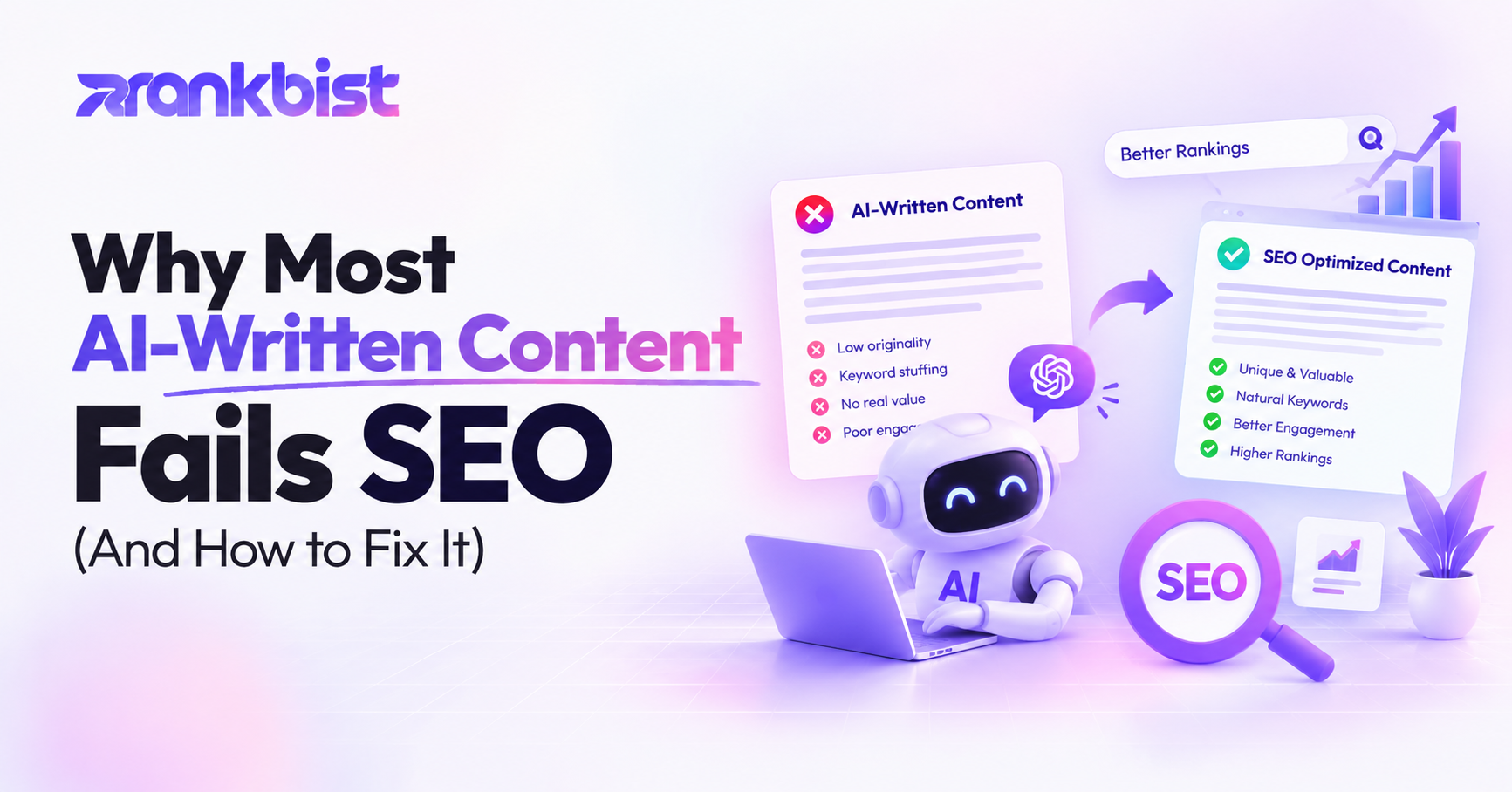
AI writing tools have made it possible to produce articles in minutes. Yet most of that content never ranks for anything meaningful. Traffic stays flat, rankings stagnate, and the pages eventually get ignored by both users and search engines.
This is not because AI is “bad.” It is because most people use AI as a finished-content machine instead of a drafting and research assistant. The difference between those two approaches determines whether the content has any chance of performing.
The Core Problems with Raw AI Content
1. Lack of Genuine Experience
Google’s quality systems look for signals of first-hand experience. AI models do not have personal experience. They generate plausible-sounding text based on patterns in training data. The result often feels generic and detached.
Compare these two passages:
AI-style:
It is important to conduct thorough keyword research before creating content. This helps ensure the content aligns with what users are searching for.
Human + experience style:
When we analyzed 50 client sites last year, the pages that ranked fastest almost always targeted keywords where the site already had some topical authority. Starting from zero on a completely new topic took significantly longer.
The second version contains specific, lived observation. That difference matters.
2. Weak or Missing E-E-A-T Signals
Experience, Expertise, Authoritativeness, and Trustworthiness still matter. Raw AI content often lacks:
- Clear authorship
- Credentials or background of the writer
- Original data or case studies
- Transparent sourcing
- First-hand perspective
3. Predictable Structure and Phrasing
AI models tend to produce similar sentence rhythms, transition phrases, and section structures. Over time this creates a detectable pattern. Content that feels mass-produced is less likely to be treated as high-value.
4. Factual Softness and Hallucinations
Even advanced models occasionally invent statistics, studies, or specific claims. When these errors are published, they damage trust — with users and with search systems that increasingly cross-check information.
5. Thin Topical Coverage
AI often stays at a surface level. It covers the obvious points but misses the nuanced questions that real users (and ranking pages) address. The result is content that is “correct” but incomplete.
How to Turn AI Drafts into Content That Can Rank
The solution is not to avoid AI. The solution is to change the workflow.
Step 1: Use AI for Research and Outlining, Not Final Writing
Strong process:
- Define the search intent and target audience clearly.
- Research the top-ranking pages and the questions people actually ask.
- Use AI to help generate a detailed outline and identify gaps.
- Decide what original experience, data, or perspective you will add.
Step 2: Inject Real Experience and Original Insight
Before writing the draft, list 3–5 specific observations, results, or lessons from real work. These become the backbone of the article. AI can help expand around them, but the core insights should come from you or your team.
Step 3: Write or Heavily Edit the Critical Sections Yourself
Especially important sections:
- Introduction
- Any claims that involve results or recommendations
- Conclusions and key takeaways
- Answers to the main user questions
Let AI handle supporting explanations, expansions, and first drafts of less critical sections if needed.
Step 4: Fact-Check Aggressively
Any statistic, study, or specific claim should be verified. Replace vague AI statements with accurate, sourced ones. If you cannot verify something, remove it or clearly mark it as opinion.
Step 5: Improve Specificity and Concrete Language
Replace generic advice with concrete details:
- Numbers
- Tools used
- Time frames
- Before/after outcomes
- Specific examples
Step 6: Strengthen E-E-A-T Elements
- Clear author name and bio
- Link to author page or credentials
- Citations and external sources where appropriate
- Visible last-updated date
- Original images, screenshots, or data visualizations when possible
Step 7: Edit for Natural Rhythm and Voice
Read the content aloud. AI writing often has a monotonous cadence. Vary sentence length. Remove repetitive transitions (“Furthermore,” “In addition,” “It is important to note”). Make it sound like a knowledgeable human wrote it.
A Practical Editing Checklist
When reviewing an AI-assisted draft, ask:
- Does this contain at least a few insights I could only know from experience?
- Would a reader learn something they could not get from the top 5 ranking pages?
- Are all factual claims accurate and properly supported?
- Is the author clearly identified?
- Does the content answer the search intent better than competing pages?
- Is any section pure filler that could be cut?
If the answer to the first two questions is no, the page is unlikely to perform well for competitive terms.
When AI Content Can Work Well
AI-assisted content performs best when:
- The topic is informational and not highly YMYL
- A knowledgeable human directs the process and edits heavily
- Original experience or data is added
- The content is significantly more helpful than competing pages
It performs worst when:
- It is published with minimal editing
- It targets competitive commercial or YMYL queries
- It lacks any original contribution
- Multiple near-identical AI articles are published across a site
Measuring Whether Your AI-Assisted Content Is Working
Track:
- Rankings for target queries
- Organic traffic and engagement metrics (time on page, scroll depth, bounce rate)
- Search Console impressions and click-through rate
- Whether the page is being cited or referenced elsewhere
Content that ranks and attracts engaged users is succeeding, regardless of how much AI was used in the process. Content that sits at position 30 with high bounce rates is not.
Final Thoughts
AI is an excellent tool for accelerating research, outlining, and first drafts. It is a poor substitute for expertise, experience, and careful editorial judgment.
The sites that treat AI as a force multiplier for skilled humans will continue to publish content that ranks and builds trust. The sites that treat AI as a content vending machine will keep wondering why their pages never move.
Quality is still the constraint. AI simply changes how fast you can reach that quality — or how fast you can produce mediocre pages at scale. The choice is yours.
Frequently asked questions
Does Google penalize AI-generated content?
Google focuses on content quality and helpfulness, not the production method. Low-quality AI content performs poorly; high-quality AI-assisted content can rank well.
Can AI content rank without human editing?
Rarely for competitive queries. Human expertise, original insight, and careful editing remain critical.
What is the biggest weakness of most AI content?
Lack of genuine experience, generic statements, and weak E-E-A-T signals.
Rank faster with Rankbist
The automated SEO engine that finds what holds your pages back and fixes it.
- Free plan, no card needed
- AI fixes in one click
- Real Google rankings and indexing